Irshaad AI
An advanced AI coaching and guidance platform featuring real-time voice interactions and a premium neon-lime dark mode—built with TypeScript and LiveKit.
The premium landing page of Irshaad AI, featuring a modern neon-lime dark mode and dynamic grainy mesh gradient background.
Project Overview
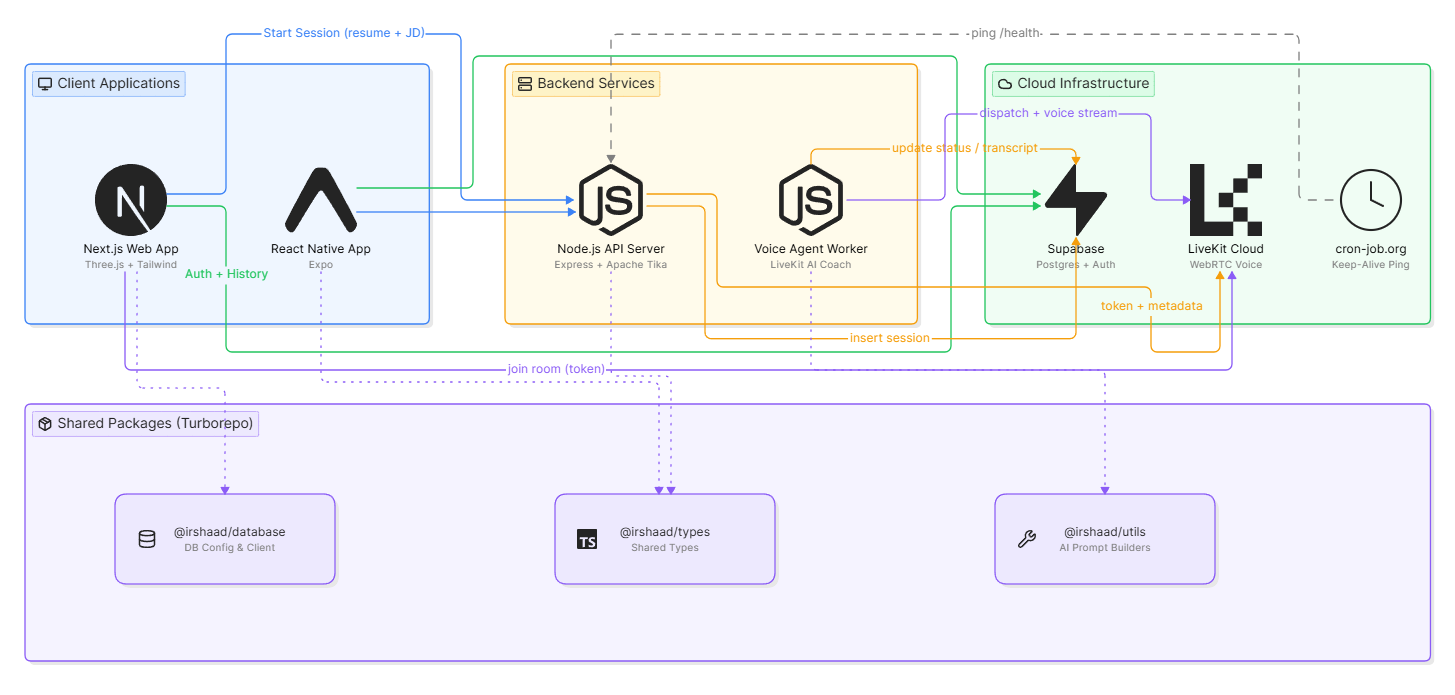
Irshaad AI (from the Arabic root meaning 'guidance') is an advanced AI coaching platform providing real-time voice interactions across a unified web and mobile ecosystem. Built using a Turborepo monorepo architecture, it features a Next.js web application styled in a neon-lime dark mode with a dynamic grainy gradient, a React Native mobile app, a LiveKit-powered voice agent worker, and a dedicated Node.js context server for memory-efficient text extraction and knowledge processing.
Role
Full-Stack Developer
- AI Integration Specialist
Tech Stack
Backend & Architecture
- Real-time voice agent worker built on LiveKit with custom agent logic (coach.ts) and Voice Activity Detection (VAD).
- Dedicated Express context API server managing heavy file ingestion and parsing via native pdf-parse and mammoth libraries.
- Integrated real-time API quota management and model error propagation to dynamically notify users of session limits on the frontend.
- Event-driven architecture using Supabase webhooks to construct rich contextual memory for the AI coach.
- Unified PostgreSQL data layer serving both web and mobile applications securely.
- Scalable microservice ecosystem organized within a Turborepo to share code seamlessly across frontend and backend.
Frontend & UX
- Immersive web interface overhauled with a premium neon-lime dark mode, custom navbar, scroll-to-top button, and interactive layout structures.
- Dynamic global backgrounds featuring custom grainy mesh gradients and interactive 3D objects powered by React Three Fiber.
- Polished authentication flows with a glassmorphic login card, responsive design, and integration with Supabase Auth.
- Interactive landing page displaying dynamic topic marquees and seamless navigation pathways to access the voice coach.
- Cross-platform compatibility with a React Native mobile app sharing utilities, schemas, and configurations via Turborepo.
App Architecture Diagram
Challenges & Technical Solutions
Managing shared code and configurations across completely distinct platforms (Next.js web, React Native mobile, Node.js servers).
Architected a Turborepo monorepo with dedicated shared packages for database types, utilities, and configurations, ensuring strict type safety and code reusability.
Handling complex document ingestion and parsing for AI context without blocking the real-time conversational loop.
Decoupled file processing into a dedicated Express API server using memory-efficient libraries to parse uploaded resumes, keeping the background worker completely unblocked.
Achieving low-latency, natural voice interactions with an AI model across both web and mobile platforms.
Deployed a centralized LiveKit agent worker to process conversational context and stream audio responses in real-time, drastically reducing client-side compute requirements.
Severe cold-start delays (50+ seconds) caused by the backend API server going to sleep after periods of inactivity on Render free hosting tier.
Implemented an automated 'pre-warming' system using an external cron job to continuously ping the server's health endpoint, guaranteeing instant room creation and zero-latency API availability.